Holiday baking season is here · Free local delivery on $250+ in MA & $500+ in RI, NH & ME · Warehouse pickup in Brockton · Shipping chocolate? Add insulated shipping.
Holiday baking season is here · Free local delivery $250+ MA · $500+ RI, NH & ME · Pickup in Brockton
How to Benefit from Buying Ingredients from Warehouses
Last Updated: November 8, 2026
Quick Summary
Buying warehouse ingredients lowers unit costs, widens selection, and reduces interruptions to production, but savings only appear when you can use the volume before it spoils. Compare unit prices rather than shelf tags, and match every order size to your actual weekly draw.
A warehouse sells you a supply, while a supermarket sells you a package.
Unit pricing means dividing total cost by weight or count to compare options equally.
The break-even point is the volume at which bulk savings cover your added costs.
Estimate how much you will use before a product turns, and buy to that number.
We keep more than 5,000 in-stock items for professional kitchens with warehouse pickup in Brockton, MA.
Ready to buy smarter in bulk?Professional-grade ingredients with warehouse pickup, local delivery, and wholesale support.
Why Warehouse Ingredients Belong in a Professional Kitchen
The benefits of buying ingredients from warehouses come down to three things: lower unit costs, wider selection, and fewer interruptions to production. At Specialty Food Source in Brockton, MA, we have supplied professional kitchens for decades, and the pattern is consistent. Chefs who buy warehouse ingredients in the right quantities spend less time sourcing and more time cooking.
Here is the distinction that matters. A supermarket sells you a package. A warehouse sells you a supply. That difference shapes everything from how you price a menu to how often someone has to leave the kitchen to restock.
For pastry and baking teams, the payoff is especially clear: professional-grade stock opens up the best professional ingredients for pastry chefs, from couverture to specialty flours, without hunting across multiple retailers.
Is It Actually Cheaper to Buy in Bulk?
Yes, but not automatically. Bulk buying lowers the unit price while raising the total spend, and those two numbers pull in opposite directions. The savings only appear when you can use the volume before it spoils.
A common mistake is comparing shelf tags instead of unit prices. A 25 lb bag of flour and a 5 lb bag are not the same product in a cost conversation until you divide by weight. Do that, and the gap becomes obvious.
How to Run a Unit-Price Comparison
Unit pricing is the practice of dividing a product's total cost by its weight or count to compare options on equal footing. It takes about five minutes and prevents most bad bulk decisions.
Record the total cost of each size option
Divide by ounces, pounds, or units to get cost per measure
Add delivery or fuel costs to each option
Estimate how much you will actually use before spoilage
Compare the adjusted unit price, not the sticker price
Check whether a membership fee changes the break-even point
The break-even point is the volume at which bulk savings cover your added costs. Below it, the smaller pack wins. Above it, bulk wins clearly. Most kitchens overestimate how much they will use, so be honest about weekly production.
Bulk Bread Flour for Bakeries: What to Check Before You Commit
Bulk bread flour for bakeries is a commitment, not a convenience purchase. Flour is the largest dry input in most bread programs, so the specification matters more than the discount.
Start with protein content and consistency. A flour that varies between lots will vary your loaves, and no cost saving survives an inconsistent product. Ask how the supplier stores it and how quickly stock turns over.
We stock a certified gluten-free option, Measure for Measure Gluten Free Flour in a 25 lb bag, which substitutes cup for cup in non-yeasted recipes. For yeasted bread, a dedicated bread flour is the correct choice.
Watch out: buying a full pallet of a flour you have not tested in production is the fastest way to convert savings into waste.
Bulk Ingredient Storage Best Practices
Storage decides whether bulk buying saves money or loses it. A cool, dry, sealed storeroom with clear labeling and first-in-first-out rotation protects both quality and margin, but the practical work is in the numbers: what temperature, what shelf life, and what portion size you actually draw each week.
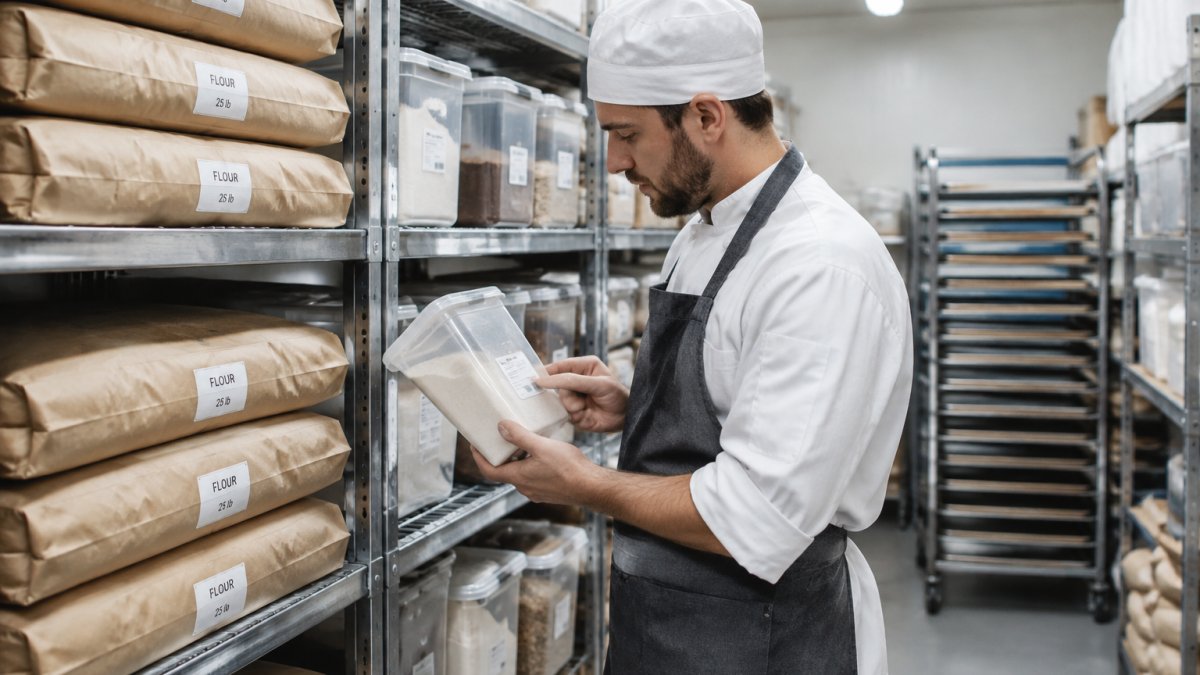
Baker checking date labels on containers in a well-organized storage room with stacked bags of ingredients.
Set the room before you set the order
A dry storeroom should stay cool and stable, away from ovens, dish pits, and direct sun. Keep dry goods off the floor and away from walls so air can move, and keep the door closed. For refrigerated and frozen warehouse items, the cold chain is the whole game: check the receiving temperature before you sign, and move product into your own cooler or freezer immediately rather than letting it sit on a dock.
Label every container with the date received, not just the date opened. Rotate stock so older product moves first, and store gluten-free flour on a separate rack from wheat flour to avoid cross-contact. Keep hygroscopic items, such as corn syrup solids, tightly sealed; they pull moisture from the air and can clump when the seal fails.
Match shelf life to your weekly draw
Shelf life drives your order size. The working rule is simple: estimate how much you will use before the product turns, and buy to that number, not to the discount. If a product turns slowly, buy the smaller format and accept a higher unit price. That is not a loss; it is spoilage prevention.
A practical planning method is to write down your weekly draw for each high-volume item, multiply by the weeks you can safely store it, and compare that figure with the pack size on the shelf. If the pack is larger than the safe-storage figure, either split the order with another buyer or step down a size. Portioning on receipt, into sealed containers sized to a day or a batch, is the single most reliable way to stop a bulk bag from becoming a bulk loss.
Watch out: buying a full pallet of a flour you have not tested in production can turn savings into waste, and the same is true of any item you have not measured against your actual weekly draw.
Build a rotation checklist
Record receiving temperature for chilled and frozen items
Date every container on receipt and on opening
Rotate so the oldest lot leaves first
Keep gluten-free stock on a separate rack
Seal hygroscopic items after every use
Review slow movers monthly and cut their order size
Storage is not a back-room chore. It is the control that makes bulk pricing pay.
The Pros and Cons of Buying Ingredients in Bulk
Bulk purchasing rewards organization and punishes guesswork. The pros are real, and so are the cons.
Pros:
Lower unit price on high-turnover items
Fewer shopping trips and lower fuel costs
Consistent specifications across batches
Less packaging waste per pound
Better menu flexibility when stock is on hand
Cons:
Higher upfront spend
Spoilage risk on slow-moving items
Storage space required
Membership or delivery costs to factor in
Less room to switch suppliers mid-season
The pros and cons of buying ingredients in bulk balance differently for every kitchen. A high-volume bakery clears volume quickly and often benefits from bulk buying. A small café with a narrow menu may not.
Freshness, Traceability, and Food Safety in Warehouse Buying
Freshness in warehouse buying depends largely on turnover. A supplier that moves stock quickly is more likely to deliver fresher product than one that moves it slowly.
Traceability is the ability to follow an ingredient back to its lot and supplier. Ask any supplier how they handle recalls and lot identification. The U.S. Food and Drug Administration publishes guidance on traceability and food safety that is worth reviewing before you sign a wholesale agreement.
Supplier standards should be documented, not assumed. Request lot coding, storage conditions, and a recall process in writing from any supplier you are considering. A supplier who cannot answer those questions is a risk to your kitchen.
Households vs. Restaurants: Two Different Warehouse Strategies
Households and restaurants should not shop the same way. The household strategy is to buy a few staples in moderate volume and prioritize shelf life. The restaurant strategy is to buy high-turnover items in volume and accept narrower margins on specialty goods.
Buyer
Order Size
Priority
Main Risk
Household
Small to moderate
Shelf life, variety
Spoilage before use
Small café
Moderate
Consistency
Storage limits
Bakery
High on flour, sugar
Specification
Lot variation
Restaurant
High on produce, dairy
Delivery reliability
Late deliveries
For a household, a 25 lb bag of flour is often a mistake. For a six-person bakery producing daily, it is routine. Match the order to the actual weekly draw.
Choosing Warehouse Ingredients in Brockton, MA
Local sourcing shortens the supply chain and keeps money in the community, but for a Brockton kitchen the practical question is logistics: who can deliver, how often, on what terms, and whether you can inspect product before you commit. That is where a nearby warehouse beats a distant one.
What to compare in a Brockton supplier
When you evaluate warehouse ingredient suppliers serving Brockton and the surrounding region, compare the same handful of items across suppliers and ask the same questions of each:
Service area and delivery days for your ZIP code
Pickup hours and whether you can inspect before buying
Minimum order for delivery versus pickup
Payment terms, including whether credit terms are available for business accounts
Whether lot codes and receiving temperatures are documented
How recalls and lot identification are handled
We keep more than 5,000 in-stock items for professional kitchens, with free local delivery on qualifying orders in Massachusetts, Rhode Island, New Hampshire and Maine, plus warehouse pickup in Brockton, MA. If you are searching for a warehouse ingredients supplier near me, start with a supplier you can visit, and bring your weekly draw numbers with you.
Households and businesses buy differently here too
A Brockton household buying staples should prioritize shelf life and pickup convenience, and should not assume a business-sized pack is a bargain. A Brockton café, bakery, or restaurant should prioritize delivery reliability, consistent specifications, and documented lot codes, because a late delivery or a variable lot can cost more than the unit-price difference. Match the order to the actual weekly draw, and use pickup to test a product before you commit to a standing order.
Watch out: a supplier who cannot answer questions about lot coding, receiving temperatures, or recall handling in writing is a risk to your kitchen, no matter how convenient the location.
Have a question about a specific item or a standing weekly order? Email support@specialtyfoodsource.com or text (508) 941-8992.
Frequently Asked Questions
Is it actually cheaper to buy in bulk?
It depends on the unit price and how much you can use before spoilage. Divide the package price by the weight to get a per-pound figure, then compare that figure with the smaller retail pack. Bulk wins when your weekly usage is high enough that the whole package gets used inside its shelf life. If a 50 lb bag outlasts your turnover, the savings disappear into waste. Run the break-even math on your three or four highest-volume items first.
What ingredients are best to buy in bulk for a bakery?
Start with items you turn over fast: flour, sugar, and ready-to-bake batters. A 25 lb bag of Measure for Measure Gluten Free Flour suits kitchens running a steady gluten-free line, while Bake'n Joy muffin and coffee cake batters in two 8 lb pails cut labor on the breakfast case. Technical ingredients such as Caravan Surfax cake emulsifier or American Gelatin 250 Bloom make sense only when your production volume justifies a 35 lb or 50 lb container.
How should a professional kitchen compare warehouse and supermarket ingredient purchases?
Compare landed cost, not shelf price. Add delivery or fuel, then divide by usable yield after trim and spoilage. A supermarket pack with a lower sticker price can lose once you account for a wasted portion. Warehouse buying also bundles fewer trips and one invoice. Track the same three items across a month and compare the true cost per usable pound rather than the price on the package.
What should bakeries consider when buying bulk bread flour?
Check protein level, mill date, and storage capacity before ordering. Bread flour needs consistent protein for repeatable rise, and older flour loses strength. Confirm the bag size matches your weekly use so nothing sits past its prime. Store it cool and dry, off the floor, and rotate oldest first. For gluten-free lines, keep those bags on a separate rack from wheat flour to avoid cross-contact.