Fall baking season is here · Free local delivery on $250+ in MA & $500+ in RI, NH & ME · Warehouse pickup in Brockton · Shipping chocolate? Add insulated shipping.
Fall baking season is here · Free local delivery $250+ MA · $500+ RI, NH & ME · Pickup in Brockton
What Makes Couverture Chocolate Different for Professional Baking
Couverture chocolate is professional chocolate with a higher cocoa butter content than ordinary baking chocolate, giving it the fluidity to coat, dip, and enrobe cleanly. At Specialty Food Source, we supply pastry teams, and their most common question is simple: which one actually performs in a working kitchen?
The answer comes down to fat.
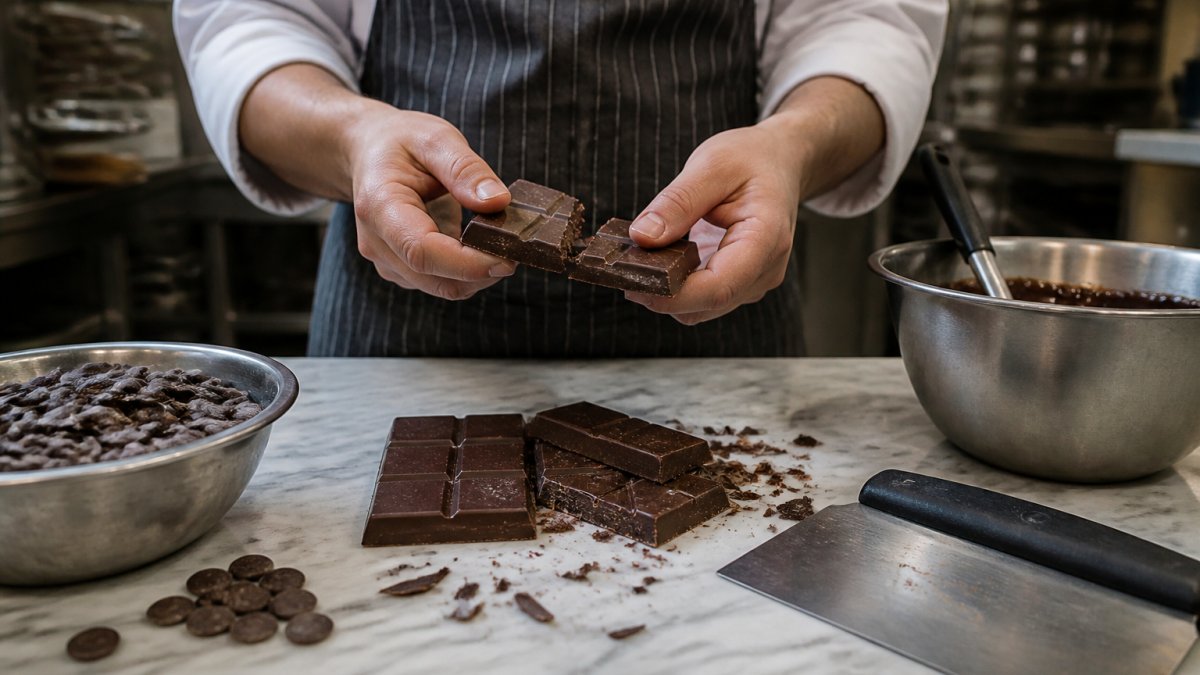
A pastry chef's hands breaking a bar of couverture chocolate over a marble counter, with callets and a tempering spatula visible nearby in a professional kitchen
What separates the two in practice:
Cocoa butter content: Couverture typically runs higher in total fat, which lowers viscosity when melted.
Tempering behavior: Cocoa butter crystallizes predictably, so tempered couverture snaps and shines.
When comparing the best couverture chocolate for professional baking, the specification sheet matters more than the label: two bars at the same cocoa percentage can behave completely differently on the bench.
Best Couverture Chocolate Brands for Professional Kitchens
The best couverture chocolate for a professional kitchen matches your application, not the highest cocoa percentage. Pastry teams generally choose between three product types.
Dark couverture: Ranges widely in cocoa percentage, from mild to intense. Best for ganache, mousse, and dark coatings.
Milk couverture: Lower cocoa solids, higher sugar and milk. Best for pralines, molded shells, and sweeter finishes.
White couverture: Cocoa butter only, no cocoa solids. Best for decorative work and flavored confections.
European-style couverture is the benchmark most pastry chefs compare against, since European manufacturers have refined cocoa butter content and conching for decades.
Side-by-Side Comparison of Professional Couverture Products
Most buying guides stop at brand names, but the spec sheet decides performance. The comparison below is organized around the numbers that matter on the bench, cocoa percentage, total fat, viscosity, flavor character, and best use.
Product Type
Typical Cocoa %
Typical Total Fat
Viscosity / Fluidity
Flavor Character
Best Use
Dark couverture, standard
54-64%
~35-38%
Medium
Balanced, cocoa-forward, moderate bitterness
Ganache, mousse, general coatings
Dark couverture, high-cocoa
70-72%
~38-42%
Medium to low
Intense, fruity or earthy depending on origin
Dark ganache, molded bonbons, plated work
Dark couverture, high-fluidity
60-64%
~38-40%
Low (thin)
Clean, mild, lets fillings lead
Enrobing, dipping, thin shells
Milk couverture
33-41%
~34-38%
Medium to low
Caramel, cream, mild cocoa
Pralines, molded shells, milk coatings
White couverture
28-35% (cocoa butter only)
~34-38%
Medium
Vanilla, dairy, no cocoa solids
Decorative work, flavored confections
Domestic craft couverture
Varies widely
Varies widely
Often medium
Origin-driven, less standardized
Ganache, small-batch confections
Two patterns matter. First, total fat and viscosity do not move together as most buyers assume, a high-fat couverture can still be thick if the manufacturer has not optimized for flow, so ask for both numbers.
Key Specifications to Compare Across Brands
Reading a spec sheet is a skill most buyers skip. The numbers that decide performance are cocoa percentage, total fat content, viscosity, and melting point.
Specification
What It Tells You
Why It Matters
Cocoa percentage
Ratio of cocoa solids and cocoa butter to sugar
Sets intensity and sweetness
Total fat content
Amount of cocoa butter present
Drives fluidity and coating thickness
Viscosity
Resistance to flow when melted
Determines dip, enrobe, and mold performance
Melting point
Temperature at which chocolate liquefies
Guides tempering and holding temperatures
Origin
Region where cocoa was grown
Shapes flavor profile and earthy notes
Emulsifier (lecithin)
Added to reduce viscosity and stabilize flow
Affects tempering behavior and mouthfeel
Added vanilla or vanillin
Flavor additive
Can mask or complement origin character
A high-fat, low-viscosity couverture is what you want for enrobing; a thicker product holds better in molded pralines where you need structure. Lecithin lowers viscosity so a manufacturer can hit target flow with less added cocoa butter.
Pro TipAsk any supplier for the viscosity rating before you commit to a pallet. A couverture that pours beautifully for dipping can be too thin for molded shells, and you will not discover that until you have already melted 20 pounds of it.
How to Read a Couverture Label Like a Buyer
Front-of-package claims are marketing; the ingredient list and spec sheet are the contract. Check these before committing to a standing order:
Ingredient order: Cocoa mass, cocoa butter, sugar, and milk should lead. If vegetable fat appears anywhere, it is not couverture.
Cocoa butter, not 'cocoa butter equivalent': CBE and CBS are vegetable fats that behave like cocoa butter but do not temper the same way.
Lecithin and vanilla: Both are common and legal, but they change melt and flavor. Note them so you can compare like with like.
At the same cocoa percentage, the product with higher cocoa butter content and a published viscosity figure is often a safer bet for enrobing and molding.
Couverture Chocolate vs Baking Chocolate: What Chefs Need to Know
Couverture chocolate and baking chocolate are not interchangeable. Baking chocolate is formulated for structure and shelf stability; couverture for flow and finish.
The practical differences:
Baking chocolate often contains added cocoa butter substitutes or emulsifiers, melts thick, and sets matte.
Compound chocolate replaces cocoa butter entirely with vegetable fats, so it never needs tempering but never tastes the same.
Couverture uses cocoa butter as its only fat, requires tempering, and delivers a snap and shine nothing else matches.
For chocolate chips in cookies, compound or baking chocolate is fine and cheaper. For dipping, enrobing, or molding, couverture is the only option that holds up.
Choosing Couverture Chocolate for Ganache and Confectionery
For ganache, choose a couverture with a moderate cocoa percentage and a smooth, creamy melt. High-fat couverture emulsifies more easily with cream, setting firm without weeping. But 'moderate' and 'high-fat' are not numbers, and a professional kitchen needs numbers.
Ganache: Matching Cocoa Percentage to Cream Ratio
Ganache is an emulsion of chocolate and cream, and the ratio depends on what you want the finished product to do:
Soft, spoonable ganache (cake filling, tart filling): roughly 1 part cream to 1 part dark couverture by weight. Sets soft at room temperature.
Sliceable ganache (truffle centers, layered cakes): roughly 1 part cream to 1.5 parts dark couverture. Sets firm enough to cut cleanly.
Firm, moldable ganache (rolled truffles, hand-dipped centers): roughly 1 part cream to 2 parts dark couverture, or 1:1 with a higher-cocoa couverture.
Cocoa percentage shifts the ratio. A 70% dark brings more cocoa solids and less sugar than a 55% dark, so it firms faster and tastes more bitter. Swapping 55% for 70% in the same recipe means a firmer set and sharper flavor, consider adding sugar or a softer cream to compensate.
Confectionery: Viscosity Is the Deciding Variable
Confectionery work splits into two jobs, and they call for different products.
Truffles and ganache centers: A dark couverture in the mid cocoa range balances sweetness and structure. Viscosity is less critical here because the chocolate is an ingredient, not a coating.
Pralines and molded shells: A milk or dark couverture with slightly higher viscosity holds shape in a mold. Too thin and the shell walls sag or the chocolate pools at the base of the cavity.
Enrobing and dipping: A high-fluidity couverture gives the thin, even shell that professional chocolatiers aim for. Too thick and you get a heavy, uneven coat that cracks when it sets.
A useful rule of thumb: if melted couverture pours from a spatula in a thin, continuous ribbon, it is in enrobing range. If it drops in a slow, heavy curtain, it is in molding range. If it barely moves, it is too thick for either and needs more cocoa butter or a warmer working temperature.
Flavor, Origin, and Batch Consistency
Flavor matters as much as function. A single-origin couverture with earthy notes tastes completely different in a ganache than a blended European-style product, even at the same cocoa percentage. Taste before buying in volume.
Three practical points for professional kitchens:
Origin character compounds in ganache. Cream and sugar mute some of the sharper notes, so a couverture that tastes intense on the bar can taste flat in a finished truffle. Taste the finished product, not just the couverture.
Blends are more consistent than single origins. A blended couverture is formulated to taste the same lot after lot, which matters when you are producing the same item hundreds of times a week. Single-origin products vary by harvest.
Batch consistency is a purchasing decision, not a kitchen one. Ask for a certificate of analysis or a spec sheet per lot, and hold your supplier to it. A couverture that performs beautifully in a sample and differently in a pallet is a supply-chain problem, not a recipe problem.
Watch OutNever let water near melting couverture. A single drop of moisture causes the chocolate to seize into a grainy, unusable paste, and no amount of stirring will bring it back. Dry every bowl, spatula, and mold before you start. The same rule applies to ganache: if your cream is cold or your bowl is damp, the emulsion can break and turn greasy.
Troubleshooting Ganache and Molded Work
Most failures trace back to temperature, ratio, or water, not the couverture itself.
Ganache is greasy or separated: The emulsion broke. Warm the mixture gently and whisk, or start with a small amount of warm cream and whisk it back in.
Ganache is too soft to roll: Increase the chocolate-to-cream ratio, or switch to a higher-cocoa couverture. Chilling helps but changes texture.
Molded shells are too thick: The couverture is too viscous for the mold. Warm it slightly, or switch to a higher-fluidity product.
Key TakeawayFor ganache, the ratio of cream to couverture matters more than the brand. For molded work, viscosity matters more than cocoa percentage. Match the product to the job, and keep a spec sheet on hand for every couverture you stock.
How to Temper Couverture Chocolate for Consistent Results
Tempering couverture chocolate means heating, cooling, and reheating it so the cocoa butter crystallizes into a stable form. Skip it and your chocolate sets soft, streaky, and dull instead of glossy and snapping.
Here is the working method we recommend:
Melt two-thirds of your couverture over a water bath to roughly 115°F for dark, 110°F for milk and white.
Cool by adding the remaining chopped couverture and stirring until it drops to about 90°F for dark, 88°F for milk, 86°F for white.
Reheat gently to working temperature, 88-90°F for dark and 86-88°F for milk and white.
Test by dipping a knife tip; it should set firm and glossy within a few minutes at room temperature.
Hold at working temperature, stirring gently, and re-test every 15 minutes.
If tempered chocolate develops streaks or a soft set, the cause is almost always temperature, not the product: too warm and it never crystallizes, too cool and it thickens before it coats.
Key TakeawayTempering is a temperature discipline, not a product feature. Even the best couverture chocolate for professional baking will fail if you melt it too hot or let it drop too cold.
Application Guide: Matching Couverture to Cakes, Cookies, and Enrobing
Match the couverture to the job, because the wrong pick wastes product and time:
Application
Recommended Type
Why
Cakes and fillings
Dark or milk couverture
Melts smoothly into batter and buttercream
Cookies and chunks
Couverture callets or chopped bars
Holds shape while adding real cocoa butter flavor
Ganache and mousse
Dark couverture, mid cocoa range
Emulsifies cleanly with cream
Truffles and pralines
Milk or dark, higher viscosity
Holds structure in molds
Dipping and enrobing
High-fluidity couverture
Thin, even, glossy shell
Callets melt evenly, need no chopping, and portion consistently, which matters when producing the same item hundreds of times a week.
For cookies specifically, couverture chunks beat standard chocolate chips on flavor every time, though they will spread slightly more in the oven. That is the cocoa butter doing its job.
Bulk Purchasing, Storage, and Cost Per Use for Professional Operations
Buying couverture in bulk changes the math, but only if you store it correctly.
What to watch:
Package size: Larger blocks cost less per pound but require chopping equipment.
Cost per use: Factor in yield, not just sticker price. A high-fluidity couverture covers more surface per pound.
Storage: Keep couverture between 60-68°F, away from strong odors, in a dry space.
Fat bloom, grayish streaks on stored chocolate, signals temperature fluctuation, not spoilage.
Wholesale ordering works best when you consolidate.
For a bakery buying couverture alongside flour and spices, one vendor and one truck removes a real scheduling headache.
Sourcing couverture that performs consistently is harder than it should be, especially when you are juggling multiple vendors and tight production schedules.
Frequently Asked Questions
What is the best brand of couverture chocolate for professional baking?
The best brand depends on your application and volume needs. Look for couverture with at least 31% cocoa butter, consistent fluidity ratings, and reliable tempering performance. European-style brands are common in professional kitchens, but regional suppliers often carry comparable couverture at better bulk pricing. Request samples before committing to a full case, and verify cocoa percentage and fluidity match your recipes for ganache, mousse, or enrobing.
What is the difference between couverture chocolate and regular baking chocolate?
Couverture chocolate contains a higher percentage of cocoa butter, typically 31% or more, which gives it a smoother melt and snap after tempering. Regular baking chocolate and chocolate chips often use less cocoa butter or substitute other fats, making them easier to melt but harder to temper properly. For ganache, truffles, and enrobed confections, couverture delivers the glossy finish and clean bite that baking chocolate cannot match.
Which couverture chocolate is best for ganache?
For ganache, choose couverture with a cocoa percentage between 60% and 70% for dark chocolate ganache, or 33% to 40% for milk chocolate. Lower-fluidity couverture works well for thick ganache fillings, while higher-fluidity options are better for glazes and coatings. Match the cocoa butter content to your desired texture: more cocoa butter means a softer set, which matters for truffle centers and layered cakes.
How do you temper couverture chocolate without a tempering machine?
You can temper couverture chocolate on a marble slab or in a bowl over simmering water. Melt two-thirds of the chocolate to 115°F for dark or 110°F for milk, then seed with the remaining third while stirring until it reaches 88°F to 89°F for dark or 86°F to 87°F for milk. Test by dipping a knife tip; if it sets glossy in a few minutes, it is ready to use for dipping, enrobing, or molding.