Fall baking season is here · Free local delivery on $250+ in MA & $500+ in RI, NH & ME · Warehouse pickup in Brockton · Shipping chocolate? Add insulated shipping.
Fall baking season is here · Free local delivery $250+ MA · $500+ RI, NH & ME · Pickup in Brockton
Why High Volume Kitchen Ingredient Procurement Breaks Down
High volume kitchen ingredient procurement is the practice of buying, forecasting, and managing bulk ingredients so a professional kitchen never runs short and never drowns in spoilage. It fails for one reason: most kitchens plan purchases around menus, not around real prep data. At Specialty Food Source, we see the same pattern in kitchens across Brockton, MA and the wider region.
A 2024 study in the journal Food Policy examined how public food buyers structure their purchasing criteria, and found that most strategies are assessed on whether they are actually actionable, not just well-written (purchasing strategies in public food procurement). That gap shows up in private kitchens too. A purchasing plan that lives in a spreadsheet but never touches the prep list is decoration.
Here's what most guides get wrong: they treat procurement as a buying task. It's a forecasting task with a buying step attached. Get the forecast wrong and no amount of negotiation saves you.
Below, we'll show you exactly how to forecast demand, buy bulk without a spoilage tax, vet suppliers, store flour properly, and negotiate like an operator.
Watch OutThe most common failure is buying to a menu instead of buying to a prep list. When the two drift apart, you either 86 a dish mid-service or throw out product you already paid for.
Ingredient Demand Forecasting That Matches Your Real Prep List
Ingredient demand forecasting is the process of predicting how much of each item your kitchen will use in a set period, based on actual prep records rather than gut feel. The best forecast starts with your prep list, not your sales report.
Pull three weeks of prep sheets and count what actually left the walk-in. Then compare that to what you ordered. The difference is your waste and your over-order, and it's usually bigger than chefs expect.
Build your forecast in layers:
Base usage: average weekly prep quantity per ingredient
Menu modifiers: items that spike on weekends, holidays, or catering days
Lead-time buffer: extra days of cover for anything with a long supplier lead time
Seasonal adjustment: items that swing with the calendar
North Central Co.'s guidance on seasonal bulk ingredient sourcing recommends understanding seasonal availability and building flexibility into procurement rather than locking rigid annual contracts. That flexibility is what lets you swap a scarce item without rewriting the menu.
Pro TipKeep a simple "par sheet" taped inside the walk-in door. Every time someone pulls an ingredient, they mark the tick. Three weeks of ticks beats any software forecast you haven't trained yet.
Bulk Food Purchasing for Restaurants Without the Spoilage Tax
Bulk food purchasing for restaurants only pays off when your storage and turnover can absorb the volume. Buy more than you can rotate and the savings vanish into the dumpster.
Consolidated Concepts' guide to buying foods in bulk for multi-location restaurants cautions that bulk buying can cause spoilage, inflate inventory, and tie up cash flow. The potential savings have to be weighed against those risks, not assumed.
So run the math before the pallet arrives:
Turnover check: will you use the full case before its best-by window?
Storage check: do you have dry, labeled shelf space for it?
Cash check: does the bulk price tie up money you need for faster-moving items?
Quality check: does the larger pack format hold up as well as the smaller one?
The same guide notes that high-volume categories offer the most visible savings, but smaller categories shouldn't be ignored automatically. Sometimes the best margin win is in a low-volume specialty item you've been buying retail.
A Supplier Evaluation Checklist for Restaurants and Bakeries
A supplier evaluation checklist for restaurants is a scored list of the things that actually affect your kitchen: fill rate, lead time, product consistency, and how fast they fix a bad delivery. Score each supplier, don't just feel it out.
K.M. Jones' research on commodity procurement strategies found that a food company's choice of procurement mechanism is closely tied to its own procurement characteristics, meaning the right supplier relationship depends on your operation, not a universal ranking (Commodity-Procurement Strategies of Food Companies).
Ability to source hard-to-find or single-origin items
Delivery windows that fit your prep schedule
Transparent invoicing with no surprise fees
Key TakeawayA supplier who scores 4s across the board beats one who scores a 5 on price and a 2 on fill rate. Missed deliveries cost more than a few cents a pound.
Bakery Flour Storage Best Practices for Bulk Bags
Bakery flour storage best practices come down to three things: keep it dry, keep it cool, and keep it labeled. Flour picks up moisture and odors fast, and a 55 lb bag that goes bad is a total loss.
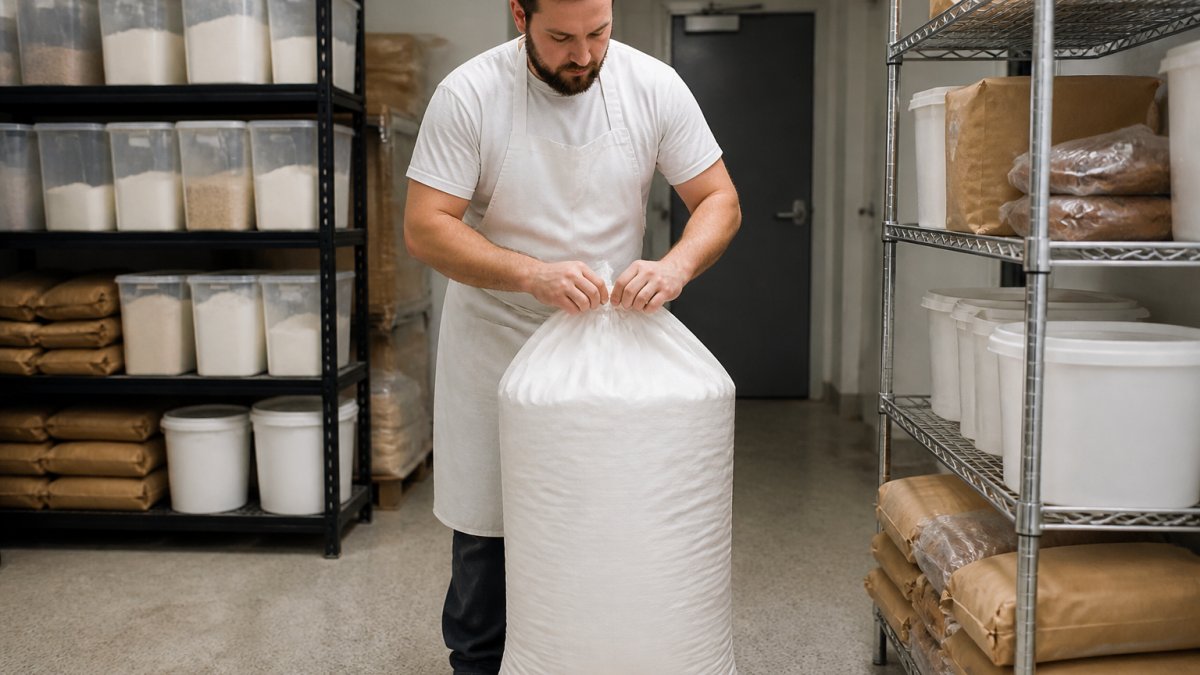
A baker in a white apron sealing a 55 lb flour bag inside a clean, dry storage room with labeled shelves and stacked ingredient containers
Store bulk bags off the floor on racks or pallets, at least six inches up and away from the wall. That airflow stops condensation and keeps pests out. Keep the room cool and dry, and never store flour next to onions, spices, or anything with a strong smell.
Once a bag is open:
Transfer to a food-grade container with a tight lid
Label it with the date opened
Use open bags first, in rotation
Keep a small working bin up front and the bulk in back
For volume buyers, a 55 lb bag of Caputo Pizzeria "00" flour is the standard for Neapolitan pizza and focaccia, and it rewards proper storage with consistent dough. You can browse the full flour collection.
CAPUTO PIZZERIA "00" FLOUR
Watch OutNever stack open bags directly on a damp concrete floor. Flour wicks moisture upward, and the bottom of the bag will mold before you ever see it.
Negotiating and Managing High Volume Kitchen Ingredient Procurement
Negotiating on high volume kitchen ingredient procurement works best when you bring data, not complaints. Suppliers respond to volume commitments and predictable ordering, not to haggling.
Come to the table with three numbers: your annual volume per item, your order frequency, and your payment history. Then ask for terms that match.
What actually moves the needle:
Standing weekly orders in exchange for a locked price
Mix-and-match bundles to hit volume tiers across categories
One invoice, one truck to cut receiving labor
Committed volume for a hard-to-find item in return for priority stock
Kessenich's 2026 foodservice trends coverage points to supply-chain transparency, local procurement, and waste reduction as priorities operators are watching. Suppliers who can show you where an item came from and when it was packed are worth more than a small price edge.
This is where working with a single wholesale partner pays off. Specialty Food Source offers wholesale accounts with dedicated support and standing weekly orders, plus bundle-and-save discounts on mix-and-match items. One rep, one truck, one invoice. For kitchens near Brockton, warehouse pickup and free local delivery on qualifying orders across MA, RI, NH, and ME keep lead times short. Search "specialty ingredient supplier near me" and you'll find plenty of options; the difference is whether they'll commit to your schedule.
Running a high-volume kitchen means the margin lives or dies on procurement. If forecasting, spoilage, and supplier chaos are eating your week, Specialty Food Source can help. We stock over 5,000 professional-grade ingredients, offer wholesale accounts with standing weekly orders, and ship nationwide from our Brockton, MA warehouse with free local delivery on qualifying orders. Get started with Specialty Food Source and put your purchasing on one rep, one truck, and one invoice. Reach us at support@specialtyfoodsource.com or text (508) 941-8992.
Frequently Asked Questions
How do restaurants manage high-volume ingredient purchasing?
They tie purchasing to a written prep list and sales history rather than ordering by feel. Managers forecast demand weekly, set par levels for each item, and review usage against invoices. A 2024 study in Food Policy found that public food procurement strategies can be categorized by how actionable their criteria are, which is why clear written standards matter. Most kitchens also consolidate orders with one or two suppliers to simplify receiving and cut freight costs.
What should a professional kitchen look for in an ingredient supplier?
Check delivery reliability, pack sizes, and freshness handling before you compare unit cost. Ask for references from similar operations, confirm whether the supplier offers warehouse pickup or local delivery, and verify how they handle damaged or short shipments. Kessenich's 2026 foodservice trend report notes that transparent supply chains and local procurement are priorities for operators, so ask where items ship from and how often stock turns over.
How should bakeries store bulk bread flour?
Keep flour in a cool, dry room off the floor, sealed in its original bag or a food-grade bin. Moisture and heat degrade gluten, so aim for stable temperatures and keep bags away from walls and direct sunlight. Label each bag with the receive date and rotate first-in, first-out. For a 55 lb bag like Caputo Pizzeria '00', transfer partial amounts to a smaller container for daily use and reseal the rest to limit air exposure.
How can a kitchen prevent ingredient stockouts?
Set par levels for every high-use item and reorder when stock hits that line, not when it runs out. Build in a buffer for your top three ingredients and track lead times from each supplier. Consolidated Concepts notes that bulk buying can tie up cash flow and inflate inventory, so balance safety stock against spoilage risk. A simple weekly count against your prep list catches gaps before service does.