Fall baking season is here · Free local delivery on $250+ in MA & $500+ in RI, NH & ME · Warehouse pickup in Brockton · Shipping chocolate? Add insulated shipping.
Fall baking season is here · Free local delivery $250+ MA · $500+ RI, NH & ME · Pickup in Brockton
Why Shipping Reliability Decides Your Bakery's Week
The global baking ingredients market is projected to reach USD 21.87 billion in 2026, and the U.S. distribution sector behind it is fragmented across 347 identified companies, according to RevenueBase's distributor landscape analysis. That fragmentation matters most to the smallest buyers. When a 6-person bakery orders 25 pounds of specialty flour, a late truck isn't an inconvenience. It's a cancelled wholesale account, a dark oven, and a Saturday market table with nothing on it.
KING ARTHUR SPECIAL FLOUR
Which culinary ingredient distributors offer the most reliable shipping for small bakeries? The honest answer is that reliability is not a brand trait. It's a set of operational choices you can audit before you place a first order: cutoffs, cold-chain handling, pallet-free options, and how the company behaves when something goes wrong.
This guide from Specialty Food Source breaks down those choices. We've supplied professional kitchens from our Brockton, MA warehouse since 1991, and we've watched small bakeries get burned by the same three or four failure points over and over. Below, we'll show you exactly what to check, what ships well, and how to build a supply chain that doesn't hinge on one truck showing up on time.
What Small Bakeries Should Look For in Culinary Ingredient Distributors
Reliable culinary ingredient distributors share four traits: published delivery schedules, no forced pallet quantities, documented cold-chain handling, and a real person who answers when a shipment arrives damaged. Everything else is marketing.
Most bakeries evaluate suppliers on ingredient quality and unit cost. Those matter, but they're not what breaks your week. What breaks your week is discovering on Thursday that your butter ships only on Tuesdays.
Order Minimums and Pallet-Free Delivery
A pallet holds roughly 40 to 48 cases stacked at standard height. If a distributor only ships full pallets, a small bakery either over-orders perishables or pays for freight it can't use.
Pallet-free delivery is the single most important feature for low-volume bakeries. Ask three questions before you commit:
What is the minimum order for free or reduced-cost delivery?
Can I mix categories, flour plus chocolate plus yeast, on one order?
Is there a standing weekly slot, or do I re-order from scratch every time?
The last question matters more than it sounds. Standing orders turn a supply chain into a schedule.
Watch OutThe most common mistake we see is a bakery chasing the lowest unit price on flour while ignoring order minimums.
Temperature Control and Fragile Item Handling
Chocolate and butter are the two categories where shipping failures become visible product failures. Semi-sweet chocolate drops arrive bloomed or fused into a block when a box sits in a hot trailer. Butter arrives soft, and re-chilled butter behaves differently in laminated dough.
Look for explicit cold-chain language, not vague promises. A distributor that ships refrigerated items overnight only, on specific days, with insulated liners and ice packs, is telling you it has thought about the problem. A distributor that says "we ship fast" has not.
Fragile items deserve their own scrutiny. Pre-baked tart shells, for example, are genuinely delicate, and honest suppliers say so up front rather than letting you discover it. If a supplier won't tell you how fragile items are packed, assume the worst.
Choosing a Food Distributor for Small Bakeries: A Practical Framework
Choosing a food distributor for small bakeries comes down to scoring candidates against the failure modes that actually cost you money, not against a feature list. Use this framework before your first order.
Score each candidate 1 to 5 on five criteria, then weight them. For a bakery under 10 people, weight delivery frequency and minimums highest, because those two determine whether you can operate at all.
Criterion
What to Check
Why It Matters
Weight for Small Bakeries
Delivery frequency
Days per week, cutoff times
Determines reorder rhythm
High
Order minimums
Dollar or case floor
Controls cash tied up in stock
High
Cold-chain handling
Liners, ice packs, ship days
Prevents melted or bloomed product
Medium
Fragile item packing
Stated breakage policy
Sets realistic expectations
Medium
Account support
Named rep, one invoice
Saves hours of admin weekly
Medium
Pro TipAsk for the shipping cutoff time in writing, then test it.
Wholesale Baking Supplies for Small Businesses: What Actually Ships Well
Wholesale baking supplies for small businesses split into two shipping profiles: shelf-stable dry goods that tolerate normal ground transit, and temperature-sensitive items that need a controlled lane. Knowing which category you're ordering tells you what to expect and what to demand.
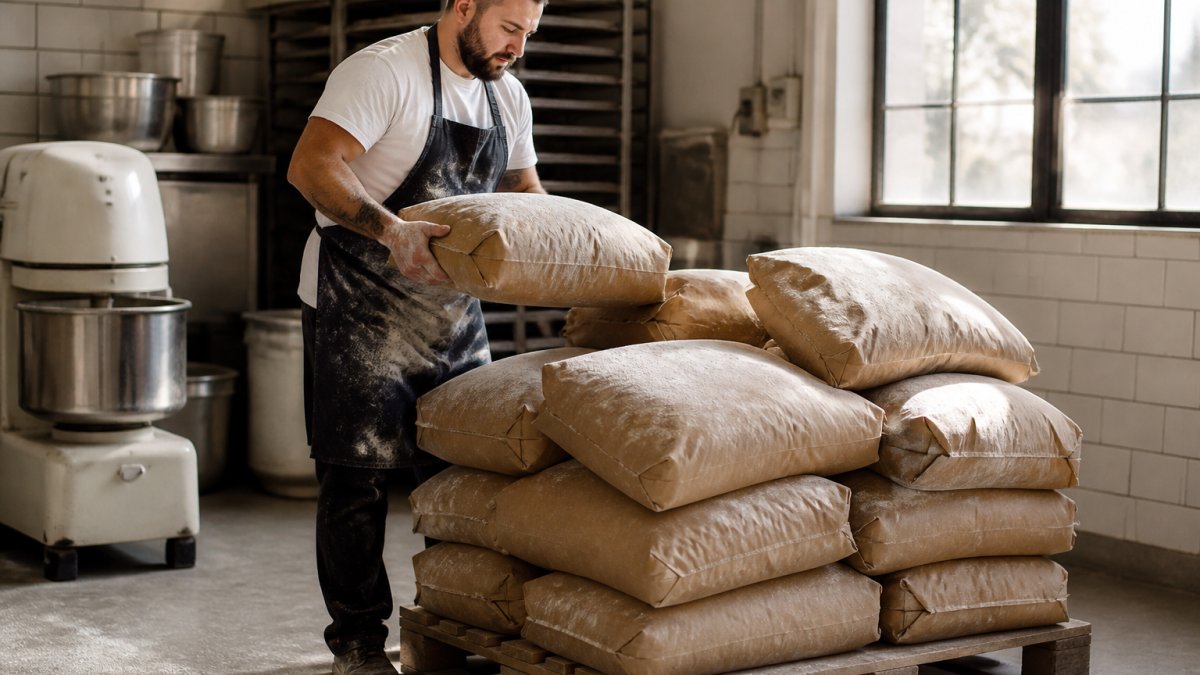
A bakery worker in a flour-dusted apron unloading a stack of 50 lb flour bags from a delivery pallet inside a small commercial bakery kitchen, morning light through the window
Flours and Dry Goods
Flour is the easiest category to ship and the easiest to get wrong on freshness. Paper sacks breathe, and a sack that sat in a humid warehouse before it reached you will already be compromised.
Order flour in formats that match your turnover. A 50 lb case of King Arthur Special Patent, a 12.7% protein short patent spring wheat bread flour, suits a bakery running hearth loaves and pan breads daily. A 55 lb bag of Grands Moulins de Paris Millstone T80, a French stone-ground flour that keeps part of the bran and germ, gives you a nuttier crumb for country boules.
MILLSTONE T80 FLOUR
Dry goods also travel well in mixed orders, which is why bundle-friendly distributors win here. You can combine flour, instant yeast, and cake mix on one truck without a temperature conflict.
Chocolate and butter need a dedicated lane. Callebaut 4M dark chocolate drops, at 4,000 count per pound, ship in insulated boxes with a 2-day upgrade when the destination forecast runs hot.
Butter is stricter. Foodservice salted butter in 1 lb blocks ships overnight only, on set days, in an insulated liner with ice packs, and a supplier may hold a shipment entirely if the forecast is too hot.
Yeast sits in between. SAF Gold instant yeast, an osmotolerant strain built for high-sugar doughs, is shelf-stable until opened, then wants refrigeration or freezing. Order it with dry goods, store it properly, and it won't limit your shipping options.
Kemin's guidance on choosing a reliable ingredient supplier makes the point that supplier evaluation in 2026 has to account for tariff-driven and logistics volatility, not just price. For a small bakery, that means asking how a supplier handles a delayed inbound shipment before it happens.
Bakery Supply Chain Management Tips for Tight Production Schedules
Bakery supply chain management tips that actually work all reduce to one idea: decouple your production schedule from your delivery schedule. If Tuesday's truck is the only thing standing between you and Thursday's orders, you don't have a supply chain. You have a single point of failure.
Three practices that hold up under pressure:
Split critical items across two suppliers. Not everything, just the two or three ingredients that stop production when they're missing.
Keep a buffer on shelf-stable staples. Flour, sugar, and yeast don't spoil quickly. Two weeks of cover costs less than one lost weekend.
Schedule cold-chain orders around ship days, not around your prep list. If butter ships Tuesday and Wednesday, your lamination day moves.
Market Research Future's baking ingredients outlook notes that growth in this market is driven by demand for both everyday staples and specialty items, which is exactly why distribution networks are under pressure to be more reliable. Specialty items have thinner substitutes. When single-origin couverture is late, you can't swap in a commodity chip without changing the product.
Key TakeawayThe bakeries that survive supply shocks aren't the ones with the cheapest suppliers. They're the ones that know, in advance, which two ingredients would stop production and have a second source already set up for both.
Local Delivery and Warehouse Pickup in Brockton, MA
Local fulfillment changes the reliability math entirely. If you're within a local delivery zone, you can often get next-day ground service or same-week delivery, which removes most of the transit risk that comes with long-haul shipping.
Specialty Food Source runs free local delivery on qualifying orders across MA, RI, NH, and ME, plus warehouse pickup in Brockton, MA. For a bakery in the Brockton area, pickup is the most controllable option on the table: you choose the day, you inspect the pallet, and nothing sits in a trailer. We also ship nationwide, with next-day UPS Ground delivery in Massachusetts, so the same account works whether you're local or shipping to a second location.
If you're searching for a culinary ingredient distributor near me, the practical test is simple. Ask whether pickup is available, ask what the local delivery zone covers, and ask what the cutoff is. A supplier with a physical warehouse in the region can answer all three without checking.
Reliable shipping for a small bakery is less about finding the perfect distributor and more about building a supply chain with no single point of failure. Specialty Food Source stocks more than 5,000 professional-grade items, offers free local delivery on qualifying orders across MA, RI, NH, and ME, and gives wholesale accounts a dedicated rep, standing weekly orders, and one invoice per delivery. Browse our flour collection to see what's in stock at the Brockton warehouse, or shop in-stock items and set up a standing order that fits your production week.
Frequently Asked Questions
What should small bakeries look for in an ingredient distributor?
Focus on four things: order minimums that fit your volume, delivery frequency, temperature control for chocolate and dairy, and whether the distributor offers pallet-free delivery. A regional culinary ingredient distributor that ships next-day UPS Ground in Massachusetts and offers free local delivery on qualifying orders solves the late-arrival problem that broadline distributors often create for small operations.
How can I ensure timely ingredient delivery for my bakery in Brockton, MA?
Set standing weekly orders with a distributor that has a local warehouse, like Specialty Food Source in Brockton. Next-day UPS Ground delivery in Massachusetts and free local delivery on qualifying orders across Eastern Massachusetts and New England mean your flour, yeast, and butter arrive on schedule. Confirm cutoff times for refrigerated items before you build your production calendar around them.
Do wholesale ingredient distributors offer local delivery options?
Regional distributors do. Specialty Food Source offers free local delivery on qualifying orders in MA, RI, NH, and ME, plus warehouse pickup in Brockton, MA. Nationwide shipping is also available. For a small bakery running a tight schedule, local delivery removes the uncertainty of long-haul freight and lets you order smaller quantities more often.
How do I balance ingredient quality with shipping reliability?
Order cold-chain and fragile items from a distributor that ships them correctly: butter overnight in insulated liners with ice packs, chocolate in insulated boxes with a 2-day upgrade in hot weather. For dry goods like flour and yeast, standard ground shipping works. Splitting your order by category keeps quality high without paying for cold-chain shipping on items that do not need it.