Fall baking season is here · Free local delivery on $250+ in MA & $500+ in RI, NH & ME · Warehouse pickup in Brockton · Shipping chocolate? Add insulated shipping.
Fall baking season is here · Free local delivery $250+ MA · $500+ RI, NH & ME · Pickup in Brockton
Why Shipping Costs Are Eating Into Your Kitchen's Margins
Minimizing shipping costs for restaurant ingredients starts with one hard truth: freight is the line item most kitchens never audit. Carriers pushed through a 5.9% general rate increase, so every delivery you accept without checking is a margin leak. At Specialty Food Source, we've watched Brockton-area kitchens cut real money by treating freight as a number to manage, not a fee to absorb. This guide from our team shows you exactly how.
Most operators focus on food cost percentage and ignore what it takes to get product through the back door. That's backwards.
Three things drive ingredient freight:
Order size relative to distance traveled
Delivery frequency and whether routes are shared
Supplier count and how many trucks you pay for
Fix those and the savings show up fast.
Bulk Ingredient Purchasing for Restaurants: The Foundation of Savings
Bulk ingredient purchasing for restaurants is the single biggest lever on freight cost, because larger orders spread a fixed delivery charge across more product. Restaurant cost-control guidance recommends consolidating purchasing with fewer suppliers, since using multiple providers often means paying multiple delivery fees (Safe & Smart Cost Reduction Strategies In Restaurants).
King Arthur 00 Pizza Flour – 50 lb Bag | Ultra-Fine Italian-Style Flour for Thin-Crust & Neapolitan Pizza
Pro TipAsk your supplier for their pallet and full-case thresholds. The jump from a half-pallet to a full pallet often adds little freight but cuts your cost per pound sharply.
How to Calculate Freight Cost Per Unit Calculation for Every Order
Freight cost per unit calculation is simple: divide total freight by total units received. That single number tells you whether a deal is real or just looks good on the invoice.
The Formula: Total Freight Divided by Total Units
Freight cost per unit = Total freight charge ÷ Total units in the shipment
A $60 freight charge on 100 units is $0.60 per unit. The same $60 on 400 units is $0.15. Same truck, same road, four times the value.
Run this on every order. Track it in a simple spreadsheet by supplier.
Order Size
Freight Charge
Units
Freight Per Unit
Small
$60
100
$0.60
Medium
$60
250
$0.24
Bulk
$60
400
$0.15
When Freight Makes a Bulk Order More Expensive Than a Smaller One
A bulk order loses when the freight jump outpaces the product savings. If a bigger order adds $150 in freight to save $100 on product, you lost $50.
Watch for surcharges on oversized or heavy pallets. Those flip the math fast.
Watch OutChasing a bulk discount without checking freight per unit is the most common mistake we see. The bigger invoice often costs more per usable pound.
Restaurant Inventory and Order Planning to Avoid Emergency Shipments
Restaurant inventory and order planning prevents the costliest shipments of all: emergency runs. A rushed order means a single-item delivery, expedited freight, and no chance to consolidate.
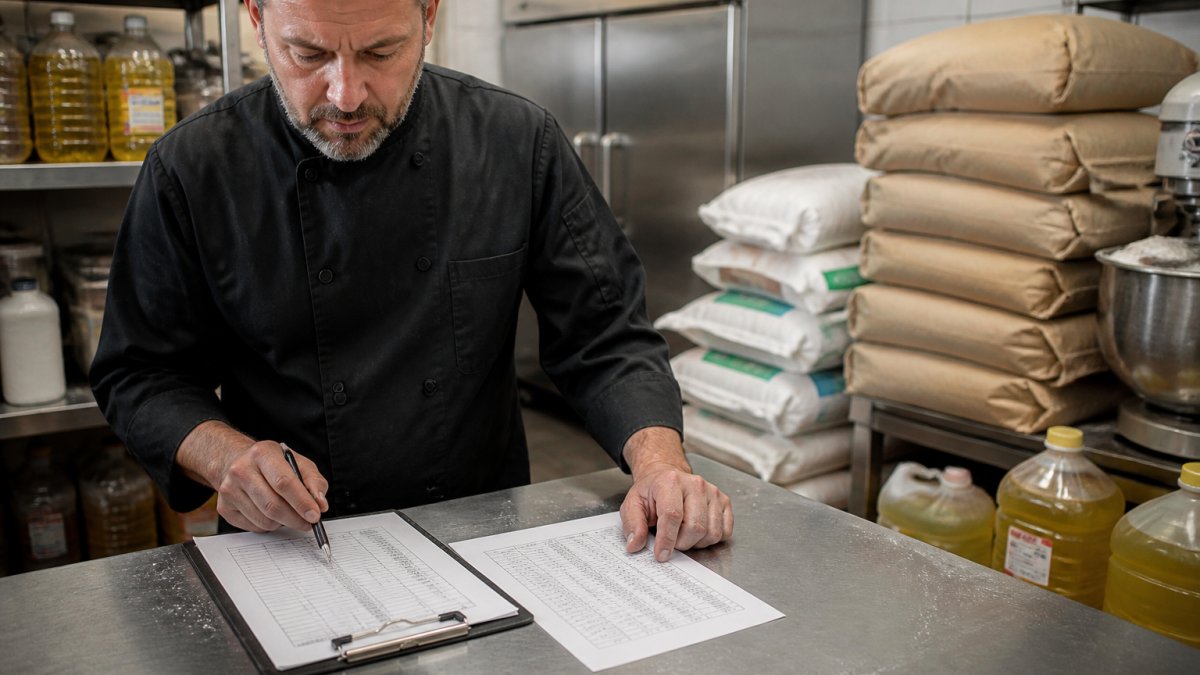
A restaurant kitchen manager reviewing inventory sheets and a clipboard on a stainless steel prep table, with stacked bulk flour bags and oil containers visible in the background
Build a par-level system for your top 20 ingredients. Count twice a week. Order on a fixed schedule so deliveries stack onto one truck.
Set a reorder point for each staple
Group orders by delivery day, not by need
Keep two weeks of shelf-stable backup on hand
Planning is the same discipline applied to freight.
Local Delivery Versus Nationwide Shipping for Ingredients
Local delivery versus nationwide shipping for ingredients comes down to distance and volume. Local wins on freight almost every time, but nationwide shipping makes sense for specialty items you cannot source nearby.
When Local Pickup or Delivery Wins
Local wins for heavy, high-volume staples. Flour, oil, and bulk pantry goods cost the most to ship by distance.
Aria Extra Virgin Olive Oil - Premium Cold-Pressed Olive Oil, 2 x 10 Liter
Specialty Food Source offers free local delivery on qualifying orders across MA, RI, NH, and ME, plus warehouse pickup in Brockton. For a bakery near us, that removes freight from the equation on core items.
When Nationwide Shipping Makes Sense
Nationwide shipping makes sense for hard-to-find items with no local source. Single-origin couverture, heirloom grain flours, and specialty spices often justify the freight.
Run the per-unit math before you decide. If the item is light and high-value, shipping stays cheap.
Key TakeawayMatch the fulfillment method to the product. Heavy staples go local; rare specialty items can ship nationwide without wrecking your numbers.
Negotiating With Suppliers to Reduce Shipping Costs
Negotiating with suppliers cuts freight when you bring volume and consistency to the table. Suppliers price delivery around predictability, so a standing weekly order earns better terms than scattered rush buys.
What works:
Commit to a standing weekly order for core items
Ask for free freight above a set order threshold
Consolidate to one rep, one truck, one invoice
Time deliveries to off-peak windows
A single supplier relationship removes duplicate delivery fees entirely. TapTouch POS notes that locally sourced ingredients may reduce shipping costs, and a steady local partner does the same (How to Reduce Ingredient Costs Without Sacrificing Quality).
For kitchens near Brockton, our wholesale accounts pair a dedicated rep with standing weekly orders, so freight gets planned instead of paid twice.
Common Mistakes That Inflate Ingredient Shipping Costs
The biggest mistake is ordering too often in too-small amounts. Each small order carries its own freight, and those charges add up faster than any product price.
Other cost inflators:
Splitting one order across three suppliers
Skipping the per-unit freight check
Letting emergency runs become routine
Ignoring heavy-item surcharges
Never asking for a freight threshold
Fix the ordering rhythm and most of these disappear. Consolidation is the cure.
Watch OutPaying three delivery fees for one week's needs is a silent margin killer. Consolidate to one truck and the savings are immediate.
Conclusion
Freight is the quiet cost that eats kitchen margins, and most operators never measure it. Start with the per-unit formula, consolidate your orders, and plan deliveries instead of reacting to them.
Specialty Food Source makes that easier. We stock over 5,000 professional-grade ingredients, offer free local delivery on qualifying orders across New England, and run warehouse pickup in Brockton. Our wholesale accounts give you one rep, one truck, and one invoice, with bundle discounts on mix-and-match items.
Shop in-stock items at Specialty Food Source and put your freight savings back where they belong. Questions? Reach us at support@specialtyfoodsource.com or text (508) 941-8992.
Frequently Asked Questions
How can restaurants reduce shipping costs for ingredients?
Consolidate orders with fewer suppliers to avoid multiple delivery fees, buy in bulk to spread freight across more units, and plan inventory so you are not paying for emergency shipments. Restaurant cost-control guidance recommends sticking with one primary provider where possible because using multiple providers can mean paying multiple delivery fees. Calculate freight cost per unit before every order so you know when a larger order actually saves money.
Does buying ingredients in bulk reduce shipping costs?
Bulk purchasing lowers your freight cost per unit because the shipping charge is spread across more product. A single pallet of flour or a case of two 10-liter olive oil containers costs less to ship per pound than several small parcels. The key is matching bulk orders to your actual usage so you are not paying to store product you cannot turn over before it loses quality.
When does local pickup make sense for restaurant ingredient orders?
Local pickup works best when your order volume is too small to justify freight, when you need ingredients quickly, or when you want to inspect product before it enters your kitchen. If you operate near a warehouse, combining pickup with your regular supply run eliminates shipping charges entirely. For larger standing orders, local delivery may be more practical because it frees up staff time and keeps your kitchen schedule predictable.
How should restaurants account for shipping when calculating ingredient costs?
Divide total freight by the number of units in the shipment to get your true landed cost per unit, then add that to the product cost. A 50 lb bag of pizza flour at a low product price but high freight may cost more per pound than a slightly higher-priced option with consolidated shipping. Track this number over time so you can spot when a supplier's shipping terms are eroding your margins.