Fall baking season is here · Free local delivery on $250+ in MA & $500+ in RI, NH & ME · Warehouse pickup in Brockton · Shipping chocolate? Add insulated shipping.
Fall baking season is here · Free local delivery $250+ MA · $500+ RI, NH & ME · Pickup in Brockton
You avoid damaged ingredient deliveries by inspecting every pallet before you sign, counting cases against the invoice, and noting any tears, crushed corners, or soft spots on the delivery receipt. Photograph the damage, report it to your supplier the same day, and keep the goods until the claim is settled.
Never sign first and inspect later, because your signature accepts the goods as delivered.
One trained person should own receiving, with authority to refuse a damaged case.
Check the bottom layer of the pallet, since damage can hide underneath.
Photograph the whole pallet, the damaged case, the product, the label, and the signed receipt.
Report damage the same day, every time, and log repeat damage to spot patterns.
Why Damaged Ingredient Deliveries Cost More Than the Product
A crushed case of couverture or a torn bag of bread flour looks like a simple loss. It is not. Learning how to avoid damaged ingredient deliveries matters because the real cost lands on your production schedule, not your invoice.
Here is the part most guides miss. The visible loss is easy to claim. The hidden losses are not:
A missed prep window that pushes back service
Staff hours spent repacking, sorting, and calling around
Emergency buys at retail rates to cover the gap
Lost sales when a menu item comes off the board
Insurance and credits rarely cover any of that. They cover the box, not the Friday night.
That is why prevention beats paperwork every time. A distributor's shipping reliability affects damage rates long before a truck reaches your door, which is why it pays to understand reliable shipping from culinary ingredient distributors before you commit to a supplier. The rest of this guide shows you exactly how to receive, inspect, and document deliveries so damage stops costing you twice.
The Food Delivery Receiving Checklist Every Kitchen Needs
A food delivery receiving checklist is a short, repeatable set of checks your team runs at the dock before anything gets signed. It takes minutes and catches most problems while the driver is still there.
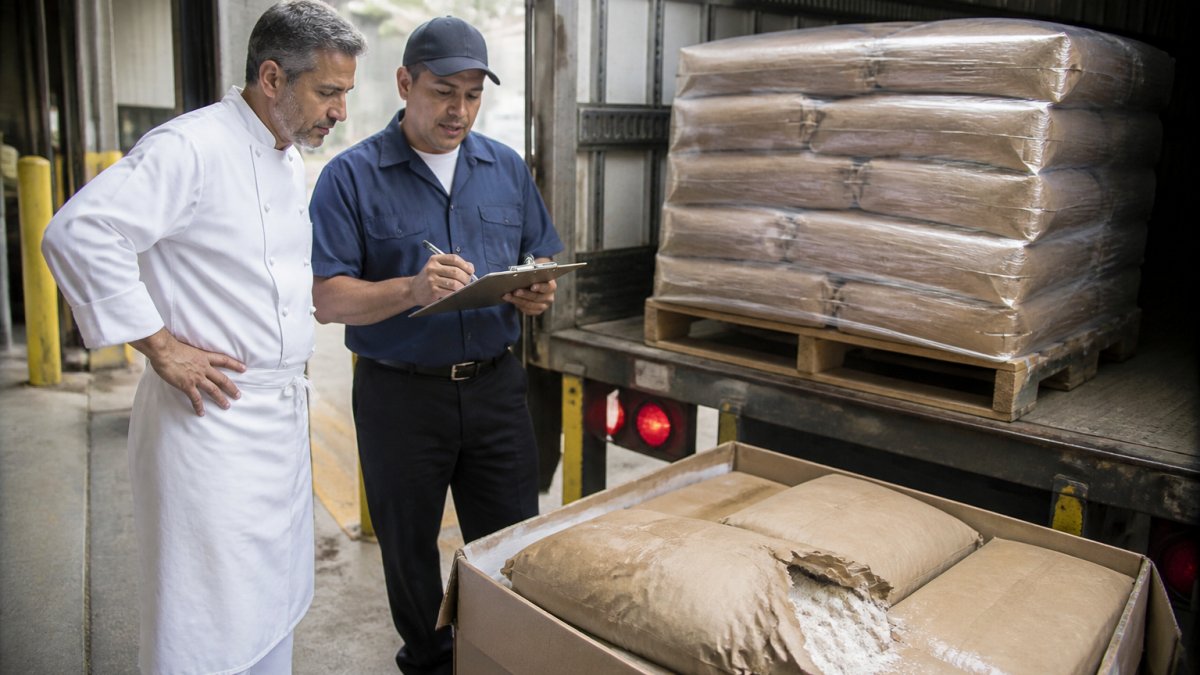
Chef and clerk inspecting a pallet of flour sacks at a loading dock
Run these checks in order, every time:
Count the cases against the invoice before unloading.
Look for crushed corners, tears, stains, and tape that has been re-sealed.
Feel for soft spots on boxes that should be rigid.
Check seals on liquids, jars, and vacuum packs.
Confirm labels match what you ordered.
Note the delivery time and the truck's condition.
What to Check Before You Sign
Never sign first and inspect later. Once your signature is on the sheet, you have accepted the goods as delivered. That single habit causes more denied claims than anything else.
Walk the pallet before the driver leaves. Look at the bottom layer, not just the top, since damage can hide underneath. If you spot a problem, note it on the delivery receipt.
For bulk flour and dry goods, you also want to judge freshness, not just physical condition. Our guide on how to verify freshness of bulk specialty flour covers the smell, texture, and packaging signs that tell you whether a load is sound.
Who Should Be at the Dock
One trained person should own receiving. Rotating the job between whoever is free creates gaps, and gaps let damage slip through.
That person needs three things:
Authority to refuse a damaged case
A phone or tablet for photos
A clear rule that nothing gets signed before inspection
A common mistake is letting a driver unload and leave while staff are mid-service. If nobody is free at the dock, schedule deliveries for a slower window. It is worth the small inconvenience.
Bulk Ingredient Packaging and Handling: What Survives the Truck
Bulk ingredient packaging and handling decide whether your order arrives intact. Heavy sacks, stacked cases, and long routes put real stress on packaging, and weak packaging fails quietly.
Not every container is built for the trip. Here is how the common formats usually hold up:
Packaging Type
Typical Weak Point
What to Inspect
Multi-wall paper sacks
Corner splits and seam tears
Bottom seams and corners
Corrugated cases
Crushed edges, moisture soft spots
Corners and box rigidity
Vacuum-sealed packs
Seal failure, punctures
Seal lines and air pockets
Rigid plastic pails
Cracked lids, loose rims
Lid seal and rim integrity
Glass jars
Chips at the neck, cracked lids
Neck, lid, and label area
Weight is the silent culprit. A pallet stacked too high crushes the bottom layer. A truck that shifts in transit scuffs and splits sacks. Ask your supplier how they palletize and stack heavy goods.
Once ingredients arrive intact, storage keeps them that way. Our guide on how to store specialty flours for freshness explains the conditions that protect bulk dry goods after receipt.
Temperature-Sensitive Food Delivery: Reading the Cold Chain on Arrival
Temperature-sensitive deliveries depend on the cold chain. Check chilled goods when they arrive rather than waiting until you open the case.
Surface temperature of the case with a probe or infrared thermometer
Condensation or sweating on packaging
Melted or re-solidified product, especially chocolate
Ice packs that have fully thawed
Off smells when you open the case
A simple rule: if the product feels warm to the touch or the packaging is wet, flag it before signing. Photograph it and note it on the receipt. Warm goods can look fine and still be unusable.
The Damaged Food Delivery Procedure: Document, Report, Resolve
A damaged food delivery procedure turns a messy situation into a clean, fast resolution. Follow three steps in order, and do not skip any.
Document. Photograph the damage before you move anything. Capture the outer box, the inner product, the label, and the delivery receipt together.
Report. Contact your supplier the same day. Send the photos and the receipt note in one message. Ask for a replacement or credit and confirm the timeline.
Resolve. Track the replacement, and log what happened so you can spot patterns. If the same item keeps arriving damaged, the problem is packaging or handling, not bad luck.
Photos win or lose claims. Take them before anything is unpacked or thrown away.
Shoot the whole pallet first
Then the damaged case from two angles
Then the product inside
Then the label and lot code
Then the signed receipt
Keep the damaged goods until the claim is settled. Suppliers may ask for them back or want a second look.
Common Mistakes That Let Damage Slip Through
Most damage gets through because of small habits, not bad luck. Here are the ones we see most:
Signing before inspecting
Letting one untrained person handle receiving
Skipping photos because "it's just one box"
Waiting days to report a problem
Not keeping the damaged product for inspection
Ignoring repeat damage on the same item
Each of these is fixable with a simple rule. The biggest one is speed. Report damage the same day, every time.
Setting Up Your Next Order With Specialty Food Source
A better receiving routine starts with a better supplier. At Specialty Food Source in Brockton, MA, we build orders so they survive the trip. We support kitchens across MA, RI, NH, and ME with free local delivery on qualifying orders.
Here is what makes ordering simpler:
Over 5,000 in-stock professional-grade ingredients
Warehouse pickup in Brockton, MA
Wholesale accounts with a dedicated rep
Standing weekly orders so your schedule stays steady
Bundle and save discounts on mix-and-match items
Independently owned since 1991 and part of JN KIDDS Distributors, we serve restaurants, bakeries, and serious home kitchens. If you are planning a smarter order, our high volume kitchen ingredient procurement tips walk you through it.
How can I prevent ingredients from being damaged during delivery?
Most damage is preventable before the truck arrives. Order in quantities that match how fast you turn product, so cases are not stacked and crushed in storage. Ask your supplier how heavy bulk items like flour and sugar are palletized before shipping. Confirm the delivery window matches your receiving hours so nothing sits unattended on a dock. If you place a standing weekly order, you can tell your rep which items are fragile. Finally, inspect every case before signing, because damage caught at the dock is far easier to resolve than damage discovered the next morning.
What should I do if ingredients arrive damaged?
Follow your damaged food delivery procedure immediately. Note the damage on the delivery receipt before you sign, and keep a copy. Photograph the outer carton, the inner packaging, and the product itself in one set of shots. Weigh or count the affected units so your claim states a specific quantity. Report it to your supplier the same day, since most carriers set short windows for filing. Set the damaged goods aside in a labeled area rather than putting them into stock, and confirm in writing whether the supplier wants them returned or discarded. A same-day report with photos resolves most claims quickly.
How should bulk ingredient packaging and handling be checked on arrival?
Start with the outer layer. Look for crush marks, water staining, punctures, and tape that has been cut and resealed. Then check the inner packaging: flour and grain bags should be intact with no sifting or leakage at the seams, and chocolate should show no bloom, melting, or warping. Confirm lot codes and dates are legible, because an unreadable code makes a freshness claim hard to support. Lift one bag from the middle of the pallet, not just the top, since compression damage hides underneath. Record the condition of each pallet on the receiving checklist before the driver leaves.
How should temperature-sensitive ingredients be checked on arrival?
Check temperature at the moment of receipt, not later. Use a probe thermometer on refrigerated items and an infrared or probe reading on frozen goods, and write the numbers on the receiving sheet with the time. Refrigerated product should feel cold throughout, not just at the surface, and frozen items should show no soft spots or refreeze ice crystals. Reject anything that arrives above its safe range or shows signs of thaw and refreeze. For couverture chocolate, look for streaking or a dull gray surface, which signals heat exposure even if the box looks fine.
Stop letting damaged deliveries throw off your week. Get started with Specialty Food Source and build a receiving routine that protects every order, from the dock to the shelf.