Fall baking season is here · Free local delivery on $250+ in MA & $500+ in RI, NH & ME · Warehouse pickup in Brockton · Shipping chocolate? Add insulated shipping.
Fall baking season is here · Free local delivery $250+ MA · $500+ RI, NH & ME · Pickup in Brockton
7 Wholesale vs Retail Ingredient Pricing Facts Every Chef Needs
Last Updated: October 26, 2026
Quick Summary
Ingredient pricing is the delivered cost of a food product at the unit a professional kitchen actually uses, after pack size, yield, and freight are accounted for. Retail shelf prices are marketing decisions that bundle in packaging, labor, shrink, and stacked margins, so they tell you almost nothing about true ingredient cost.
Keystone pricing doubles cost, cost-plus adds a fixed percentage or fee, and absorption spreads overhead across volume.
Convert every quote to delivered cost per pound or kilogram, then adjust for usable yield before comparing.
A bulk buying break-even analysis divides the larger pack's delivered cost by usable weight and compares it to the smaller pack.
Retail or small packs win when cash flow, shelf life, or menu testing make large commitments risky.
Date every bag on receipt, rotate first-in first-out, and keep par levels so bulk savings survive the storeroom.
Why Retail Shelf Prices Tell You Almost Nothing About Ingredient Cost
A retail shelf price is a marketing decision, not a cost signal. That is the first thing to understand about wholesale vs retail ingredient pricing analysis, and it is the fact that trips up most chefs who try to benchmark their purchasing against grocery-store numbers.
The USDA Economic Research Service reports that food prices in September 2026 were 2.5% higher than a year earlier, and that the Producer Price Index for All Foods stood 34% above its February 2020 reading as of September 2026, according to the National Restaurant Association. Those two numbers describe entirely different layers of the supply chain. At Specialty Food Source, we see chefs compare them constantly and draw the wrong conclusion, because a retail price bundles in packaging, shelf labor, shrink, marketing, and a retailer's margin on top of a distributor's margin on top of a manufacturer's margin.
Ingredient pricing is the delivered cost of a food product at the unit a professional kitchen actually uses, after pack size, yield, and freight are accounted for. It is not the sticker on a 5-pound bag.
That distinction matters because retail prices are set for shoppers buying small quantities with high handling costs per pound. A 50 lb bag of flour and a 5 lb bag of the same flour are not the same product economically, even when the mill is identical.
The Wholesale Food Pricing Formula Behind Every Quote
Every wholesale quote you receive is built from a markup formula, and knowing which one you are looking at tells you where the negotiating room sits. A wholesale food pricing formula is the method a supplier uses to convert its own landed cost into the price on your invoice. Three formulas dominate.
Keystone, Cost-Plus, and Absorption Markups
Keystone pricing doubles the cost. It is simple, common in broadline distribution, and leaves little room to argue unless you change the pack size or the delivery terms.
Cost-plus pricing adds a fixed percentage or a flat fee to cost, and it is the easiest formula to audit because the underlying cost is usually visible if you ask.
Absorption pricing spreads fixed overhead, warehouse space, and labor across volume, which means the same item can carry different effective markups depending on how much you buy and how often.
A common mistake is assuming wholesale always lands near half of retail. Pricing research on store versus manufacturer brands shows the gap between quality and price is rarely that clean, and the "half of retail" assumption has no basis in how modern distributors actually build quotes.
What a Wholesale Quote Should Itemize
Ask for these line items, and treat a quote that hides them as a quote you cannot compare:
Unit cost at the pack size quoted
Freight or delivery charge, stated separately
Fuel or minimum-order surcharges
Payment terms and any early-pay discount
Case pack and whether mixed pallets are allowed
If you want to go deeper on how high-volume kitchens structure these negotiations, our guide to high volume kitchen ingredient procurement tips covers the ordering patterns that earn better terms.
How to Compare Bulk Ingredient Cost per Unit Without Fooling Yourself
The only number worth comparing is bulk ingredient cost per unit on a delivered basis, expressed in the unit your recipes use. Everything else is noise.
Start by converting every quote to cost per pound or per kilogram, delivered, then adjust for usable yield. A flour quoted at one price with a 50 lb pack and another at a lower price with a 25 lb pack are not comparable until freight is divided across the weight actually shipped.
The Delivered-Cost Worksheet
Run every quote through the same five lines before you decide anything:
Running a Bulk Buying Break-Even Analysis on Your Own Menu
A bulk buying break-even analysis answers one question: how many units must you use before the larger pack beats the smaller one, once storage and spoilage are priced in?
The formula is straightforward. Take the total cost of the larger pack, delivered, and divide it by the usable weight. Compare that to the same figure for the smaller pack. The difference per pound, multiplied by your monthly usage, is your monthly saving. Then subtract the cost of the storage space and the expected spoilage on the extra volume.
Here is how that plays out in practice. King Arthur 00 Pizza Flour in the 50 lb bag is milled to an ultra-fine 00 grind at roughly 11.5% protein, built for Neapolitan and thin-crust pizza and for high-heat ovens running 700-900°F. A pizzeria turning through multiple bags a week reaches break-even almost immediately. A cafe making flatbreads twice a week may not, and the honest answer there is to stay small until volume justifies the pallet.
If you are weighing whether to step up to pallet scale, buying flour by the pallet walks through the practical side of that decision.
When Retail Still Wins: Shelf Life, Cash Flow, and Small Batches
Bulk loses more often than bulk sellers admit. Three situations favor retail or small-pack purchasing, and recognizing them saves money rather than costing it.
Cash flow. A large pack ties up working capital in inventory sitting on a shelf. For a young kitchen, that cash is better deployed elsewhere.
Shelf life. Flour, chocolate, and dairy all have a window. Buying six months of a specialty item you use once a week is not a saving, it is a slow write-off.
Small batches and menu testing. When you are trialing a new pastry or a seasonal menu, a 50 lb bag is a commitment to a recipe you have not validated yet.
The contrarian point: wholesale is not automatically cheaper per usable unit once you price storage and waste honestly. Run the break-even math before you assume scale wins.
Ingredient Inventory and Spoilage Management That Protects the Savings
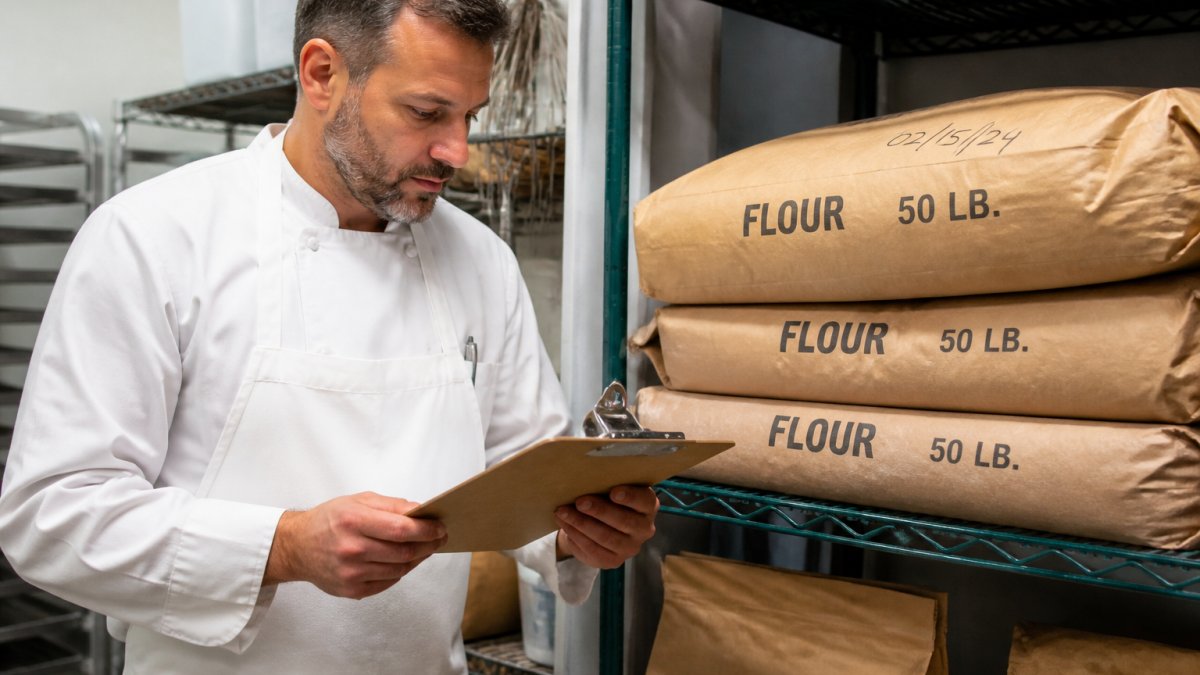
A baker in a white apron checking a clipboard beside a labeled dry-storage rack holding stacked 50 lb flour bags, with a date label visible on the top bag
Ingredient inventory and spoilage management is the practice of tracking what you hold, how old it is, and how fast it moves, so that bulk savings survive contact with your storeroom. A bulk discount erased by spoiled product is not a discount.
Set up three habits. First, date every bag on receipt and rotate first-in, first-out on the rack. Second, keep a simple par level per item so you reorder on usage rather than on habit. Third, separate gluten-free flour onto its own rack to avoid cross-contact, and store all flour cool and dry.
Specialty flours need more care than all-purpose. Our guide to how to store specialty flours for freshness covers the storage conditions that keep a 50 lb bag performing to the last pound.
Start With a Bulk Flour Order From Our Brockton Warehouse
Specialty Food Source has supplied professional kitchens since 1991 as an independently owned, JN KIDDS Distributors company, and we stock over 5,000 items built for restaurants, bakeries, and serious home kitchens. If you are ready to test the wholesale side of this analysis on a real order, start with our bulk flour range and compare the delivered cost per pound against what you are paying now.
We hold warehouse pickup in Brockton, MA, free local delivery on qualifying orders across MA, RI, NH, and ME, and nationwide shipping, along with wholesale accounts that give you one rep, one truck, and one invoice. For questions about an order, reach us at support@specialtyfoodsource.com or text (508) 941-8992.
Frequently Asked Questions
What is the difference between wholesale and retail ingredient pricing?
Retail pricing is the shelf price you pay for a package sized for a home kitchen, and it carries the store's full margin plus packaging and handling. Wholesale pricing is quoted to businesses buying in case or pallet quantities, so the cost per pound drops as volume rises. The gap is not fixed. Wholesale is not automatically half of retail, and markup methods vary by supplier. Compare delivered cost per usable unit, not the sticker on the bag, before deciding which channel is cheaper for your kitchen.
Is buying ingredients in bulk always cheaper?
No. Bulk buying only saves money when you use the product before it declines. A 50 lb bag of flour at a low cost per pound is a loss if a third of it spoils before it reaches the oven. Bulk also ties up cash and requires dry, pest-free storage. Run a break-even check: divide the total bulk order cost by your weekly usage to see how many weeks the stock will sit. If that number exceeds the ingredient's practical shelf life in your kitchen, a smaller pack is the cheaper choice.
How do you calculate bulk ingredient cost per unit?
Add the product cost, freight, and any fuel or delivery surcharge, then divide by the number of usable units in the shipment. For a 50 lb bag of flour, divide the delivered total by 50 to get cost per pound, then multiply by the pounds in your standard recipe batch. Do the same for the retail pack and compare the two figures side by side. Including freight is the step most kitchens skip, and it is often what flips a wholesale quote from cheaper to more expensive on small orders.
When does buying retail ingredients make more sense than wholesale?
Retail wins for low-volume or occasional items, for testing a new menu item before committing to a case, and for perishable products you cannot turn over quickly. It also makes sense when storage is tight or when cash flow is stretched and you cannot tie up money in stock. Keep a short list of these items and buy them as needed. Route everything with steady weekly usage, flour, chocolate, and pantry staples, through wholesale so the volume discount actually lands.
The gap between a retail shelf price and a real wholesale cost is where your margin lives, and closing it starts with one honest comparison on one ingredient. Get started with Specialty Food Source and put your next bulk order against a delivered-cost worksheet, with bundle discounts, standing weekly orders, and pickup at our Brockton warehouse behind it.